Giverny Tours›Monet's House and GardensUpdated 2026-09-28
Monet’s House and Gardens in Giverny
Hours, prices and access verified by the Giverny Tours team — last checked 2026-09-28.
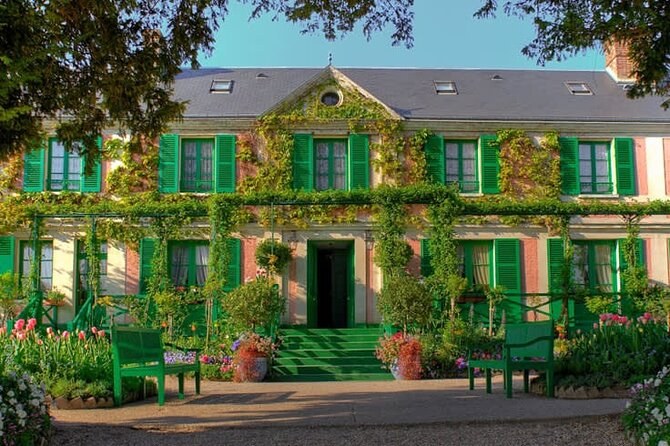
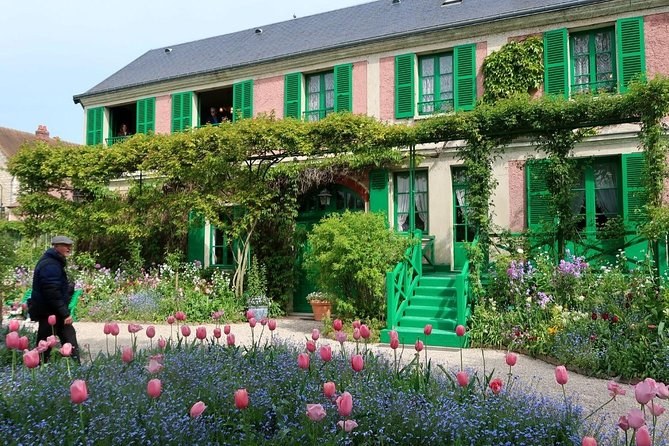
Monet’s house and gardens in Giverny were his home for 43 years, from 1883
to 1926. You walk through the pink house, then the flower garden he called the Clos Normand, then
the water garden with its green bridge. Here is what each part is, who saved it, and the order
to see it in, whichever of the Giverny guided tours you take.
Monet at Giverny, 1883 to 1926
Monet moved to Giverny in 1883 and never truly left, by the Fondation’s account. He
travelled to paint, but he ran his family and his flowers by letter. His friends came to him:
Cézanne, Rodin and Clemenceau all visited.
Year
What happened at Giverny
1883
Monet moves into the long pink house at Giverny with his family
1890
He buys the property in the autumn and builds a new studio
1893
He buys the land across the railway line and diverts a branch of the Epte to make the pond
1897
He starts painting the water lilies
1899
He stops working in his first studio, the room you now see hung with paintings
1922
He signs the gift of the Water Lilies panels to the French State (12 April)
1923
He has a cataract operation, after eyesight trouble first noticed in 1908
1926
He dies at Giverny on 5 December, aged 86
1927
The Water Lilies panels go on show at the Orangerie in Paris (17 May)
1966
His son Michel dies and leaves the estate to the Académie des Beaux-Arts
1977-80
A Versailles curator leads the restoration; the Fondation opens in 1980
2011-14
The studio is restored, then Monet's bedroom, then Blanche's bedroom opens
The dates above come from the Fondation’s own timeline and from the history of its
restoration. You will see the traces of most of them on your visit.
The Clos Normand, the flower garden
When Monet arrived, the Clos Normand was a hectare of apple orchard and kitchen garden. A
path of cypress and spruce ran from the gate to the front door. He pulled out the box hedges and,
after many arguments with his wife Alice, cut down the spruce.
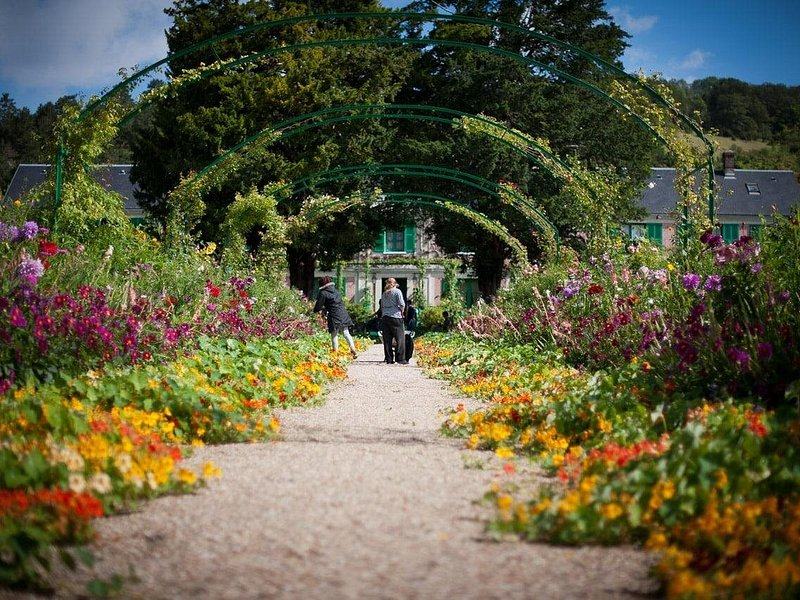
The central garden path under a run of iron arches, flower beds on both sides
Metal arches replaced the trees, and they still stand. Roses and nasturtiums line the central
path. Japanese cherry and apricot trees took the place of the apples. Thousands of flowers
followed: daffodils, tulips, narcissi, irises, Oriental poppies and peonies.
Look to the left of the path. There Monet laid out rectangular beds of a single colour each,
“like colours on a palette”, in the Fondation’s words. Today’s gardeners
replant them every year.
The water garden and the Japanese bridge
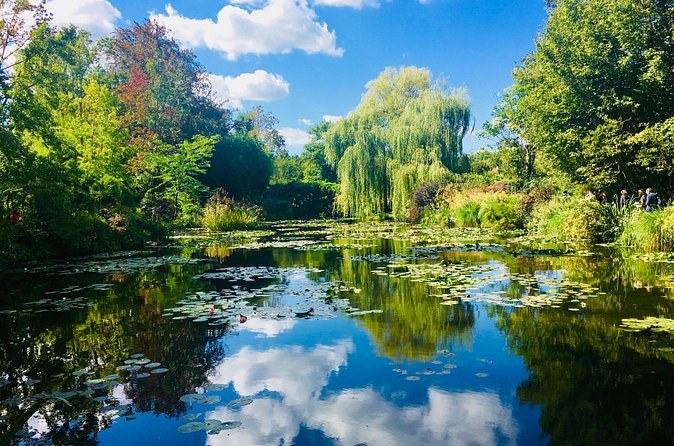
In 1893 Monet bought the land at the bottom of the Clos Normand, on the other side of the
railway line. He diverted the Ru, a small branch of the River Epte, and the pond he made became
the subject of his best-known paintings. In 1897 he began to paint its water lilies.
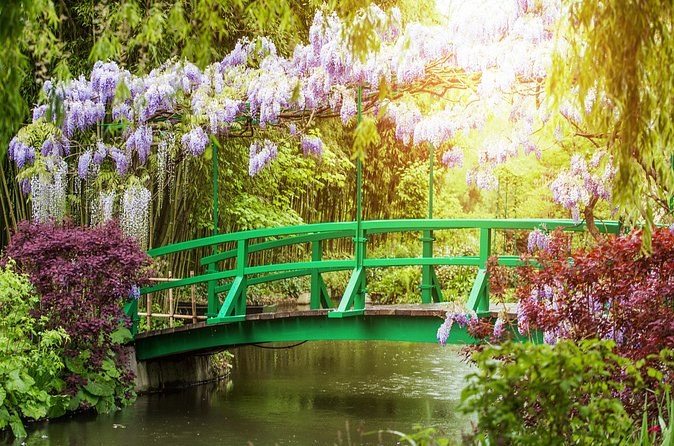
The Japanese bridge stands on the same axis as the central path. It was painted green to stand
apart from the red used in Japan. Around the water he planted bamboo, ginkgo, maple, Japanese
tree peonies, lilies and weeping willows.
The green Japanese bridge under trails of mauve wisteria
One gardener worked on the pond full time, lifting every dead leaf. Monet received his guests
here and spent hours looking at the water. Walk the loop slowly: the bridge looks different from
each bank.
The ground floor: the blue lounge, the studio and the kitchen
You start in the reading room, still called the little blue lounge. It opens onto the pantry,
where tea, olive oil, spices and eggs were kept in wall cupboards. Next comes Monet’s first
studio, where he worked until 1899.
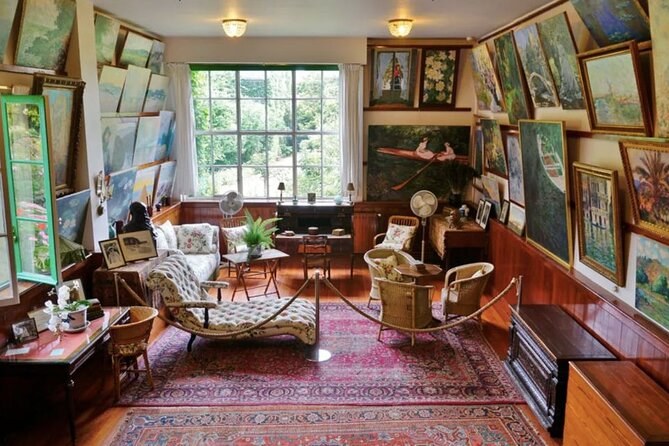
The studio was restored in 2011, with money from the Versailles Foundation. About 60 of his
paintings were reproduced and hung close together on the picture rails, as in his day. Around
80% of the furniture already in the room was kept.
A sitting room hung floor to ceiling with paintings, cane chairs on a patterned rug
At the end of your visit you come back down to the dining room. Its walls are yellow, and its
yellow furniture was modern for its time. Monet’s own Japanese prints hang there. The
kitchen beside it is lined with blue Rouen tiles, with a huge range and copper pans.
Upstairs: the family’s bedrooms
A staircase takes you to the private rooms. Monet’s bedroom was recreated in 2013. It
holds pieces that were there in his lifetime, and reproductions of paintings by his friends
Cézanne, Renoir, Signac and Caillebotte.
You pass Monet’s washroom and Alice’s, then her bedroom with a tiny sewing room.
Damask tablecloths, sewn together, line the walls of both bedrooms. The last room is the
bedroom of Blanche Hoschedé-Monet, who lived at Giverny until her death in 1947. It opened to
visitors in 2014.
The house is not wheelchair accessible. The gardens are accessible to people with reduced
mobility, and a disability card gets you priority entry at the group entrance.
From Michel Monet to the Académie des Beaux-Arts
Monet’s son Michel died in a car accident in 1966. He left the estate to the Académie
des Beaux-Arts, which owns it today. The paintings still at Giverny went to the Musée Marmottan
in Paris.
In 1977 the Académie turned to Gérald Van der Kemp, chief curator of the Château de Versailles
from 1953 to 1980. He raised most of the money from American donors through the Versailles
Foundation. About 95% of the cost of the restoration was paid by private gifts.
The Fondation Claude Monet opened the house and gardens to the public in 1980. It calls them the
second most visited attraction in Normandy. The Art Newspaper counted about 750,000 visitors in
2023.
Where the paintings are now
No original Monet hangs in the house. What you see in the studio are reproductions, placed as
he had them. The originals are in museums, most of them in Paris.
The great Water Lilies panels went on show at the Musée de l’Orangerie on 17 May 1927,
set out as Monet had asked. The Musée Marmottan Monet holds most of his work. The Fondation sells
combined tickets with both museums at its desk, for individual visitors only.
The visit runs one way, and any exit from the site is final. Plan it before you go in. The
Fondation suggests an hour and a half to two hours.
The house
The Fondation's route starts in the little blue lounge, runs through the studio and up to the bedrooms, and ends in the dining room and the kitchen.
The flower garden
The central path runs from the house steps under the iron arches, with the single-colour beds to its left.
The water garden
It lies across the old railway line at the foot of the flower garden. The path goes round the pond and over the green bridge.
See the house and both gardens before you walk back out to the street. If your tour gives
you a set time, ask your guide or leader where you meet afterwards.
Want someone to walk you through it?
Compare the Giverny tours that put a guide with you in the house and gardens, and the ones that give you an app and your own pace.
From 1883 until his death there on 5 December 1926, aged 86: 43 years. He bought the property in 1890 and made the water garden from 1893.
Why is the Japanese bridge green?
Monet painted it green to set it apart from the red traditionally used in Japan, according to the Fondation. It stands on the line of the central path of the flower garden.
Who owns Monet's house now?
The Académie des Beaux-Arts, to which Michel Monet, the painter's son, left the estate in 1966. The Fondation Claude Monet has run it since the house and gardens reopened in 1980.
What is inside Monet's house?
On the ground floor, the little blue lounge, the pantry, the studio hung with about 60 reproductions, the yellow dining room and the blue-tiled kitchen. Upstairs are Monet's bedroom, Alice's bedroom and Blanche Hoschedé-Monet's bedroom.
Are the paintings in the house real?
No. The studio's walls carry reproductions of about 60 of Monet's paintings, hung as they were in his time. The Japanese prints in the dining room are Monet's own collection.
Where can I see the Water Lilies paintings?
In Paris. The great Water Lilies panels have hung at the Musée de l'Orangerie since 1927, and most of Monet's work is at the Musée Marmottan Monet.
Is Monet's house wheelchair accessible?
No. The Fondation says the gardens are accessible to visitors with reduced mobility but the house is not wheelchair accessible. A disability card gives priority access at the group entrance on the Sente Leroy and a €6 fare.
Where these facts come from
The rooms, the gardens and the dates are the Fondation Claude Monet’s own, read from its
pages, checked 28 September 2026. The history of the restoration and the visitor figure come from Wikipedia and
the sources it cites.
Five hours door to door with an art historian: an hour inside the house, an hour across the flower and water gardens, half an hour in the village, priority admission paid.
Six people at most, meeting in the 16th: an hour in the village, then two hours in the house and gardens with your guide beside you, and ten minutes at the church.